Hedge Trimming in Limehouse

Hedge trimming in Limehouse needs a tidy, controlled approach that keeps gardens, boundary lines and planted spaces looking cared for without stripping away the natural shape of the hedge. Our service focuses on reshaping, reducing overgrowth and maintaining a neat finish that suits the plant and the setting. Whether the hedge frames a small courtyard, screens a rear garden or forms part of a wider green boundary, we work to give it a balanced outline and a healthier structure.
We handle routine hedge cutting and more involved reduction work where growth has become uneven, heavy or difficult to manage. That can include formal hedges that need crisp lines, softer mixed planting that benefits from careful thinning, and taller boundary hedges where access and reach matter as much as the final appearance. Good hedge work is about more than cutting back leaves; it is about preserving density, encouraging tidy regrowth and leaving the hedge with a clean, considered profile.
For a quick quote, send over the hedge type, approximate length and height, and a brief note on what you want done. If you already know whether it needs light shaping, a seasonal trim or a stronger reduction, mention that too. See pricing and quotes for more detail on how enquiries are handled.
Routine hedge cutting for regular upkeep
Regular hedge maintenance is the simplest way to keep growth even and prevent a hedge from becoming bulky or misshapen. Our trimming work can suit front gardens, side boundaries and shared edges where a tidy line makes the whole space feel better kept. We take care to cut back fresh growth in a way that supports the hedge’s form, rather than turning it into an over-sheared block that looks harsh or sparse.
Different species respond differently to trimming, so the approach should match the plant rather than a one-size-fits-all method. Some hedges need a light, frequent cut to stay sharp; others benefit from a fuller seasonal tidy with selective shaping. When you are planning hedge trimming in Limehouse, it helps to think about the finish you want, whether that is a level top, squared sides or a more natural outline that still looks ordered. Read more about hedge trimming if you want a clearer sense of the service.
Our team can also work around established garden features so the hedge sits well with paths, railings, fences and planting beds. That matters when the hedge is part of a visible frontage or when the boundary line needs to remain clear without losing its thickness. We aim for a finish that looks deliberate, with the hedge cut back neatly and the surrounding space left ready to use.
Shaping, reduction and recovering overgrown hedges

Some hedges need more than routine maintenance. When growth has become too tall, too wide or uneven after a missed season or two, reduction work can restore proportion without taking the hedge back so hard that it struggles to fill out again. We assess where the growth is strongest, where the hedge has thinned, and how much material can be removed while keeping a sensible shape. That lets us trim with purpose rather than simply removing as much as possible.
If a hedge has drifted outward into a path, narrowed access or started to lean into a neighbouring area, careful reduction can make a noticeable difference. We work in stages where needed, especially with dense hedges that would not suit a severe cut in one visit. Measured trimming is usually safer for appearance and recovery, and it can help the hedge keep its screening value while becoming more manageable. Garden maintenance can also complement this kind of work where other planted areas need attention at the same time.
We also consider how the hedge will look after the next flush of growth. A reduction that appears neat on day one can still leave the hedge with a lopsided or weak outline if it is not shaped carefully. That is why our work pays attention to line, balance and density, not just the amount cut away. If you are unsure whether your hedge needs a trim or a reduction, a short description of its current size and condition is usually enough to start a quotation.
Access, finish and the detail that makes a difference
Hedge trimming often looks simple from a distance, but the result depends on how the work is approached at close range. Edges need to be even, corners need to meet cleanly and the top line needs enough care to avoid dips or visible waves. On longer runs of hedge, consistency matters just as much as speed, especially where the hedge is prominent from the street or visible from several rooms or outdoor seating areas.
Where access is tighter, the work can require a more thoughtful setup so the hedge can be reached without damaging nearby planting or leaving stray cuttings in awkward places. We can work with hedges beside fences, boundaries, driveways and garden structures, keeping the cut controlled and the finish tidy. View our services overview if you want to see how hedge trimming sits alongside the rest of our garden work.
Typical hedge work may involve one or more of the following:
- light shaping to tidy fresh seasonal growth
- cutting back sides to restore a straight line
- reducing height where the hedge has become too dominant
- removing uneven growth to improve symmetry
- clearing the finished area so borders and paths remain usable
Hedge trimming alongside wider garden care
Some customers want hedge trimming as a standalone task, while others prefer it as part of a broader garden plan. When hedges are cut at the same time as lawn care, border tidying or general garden maintenance, the whole space can feel more coherent. The hedge stops dominating the view, the edges look sharper and the garden reads as one maintained setting rather than a collection of separate jobs.
Where appropriate, hedge trimming can be combined with other related services such as lawn mowing or garden clearance. That is useful if overgrowth has left grass edges blurred, clipped material needs to be removed or the hedge has been feeding debris into the rest of the garden. We can plan the work so the main cut is finished first and the surrounding space is tidied afterwards, keeping the outcome neat and practical.
For more involved outdoor projects, hedge work can also sit alongside structural or planting changes. A hedge may be trimmed before a border is renewed, or reduced before a wider layout is adjusted. In those cases, the value lies in timing and sequence as much as in the cutting itself. Getting the hedge under control first often makes everything else easier to manage.
About Limehouse

Limehouse is a district in the London Borough of Tower Hamlets, set on the north bank of the River Thames and closely associated with the historic Docklands east of the City. Its name has long been linked to the maritime past of east London, and the area developed from a riverside settlement into a place shaped by trade, shipbuilding and later redevelopment. The Limehouse Cut, an early artificial waterway completed in the eighteenth century, is one of the area’s notable pieces of infrastructure, reflecting the long relationship between transport, industry and the waterways that run through east London. Today Limehouse combines older residential streets, dockside edges and modern development, with a varied urban character that still carries traces of its working past.
Among its best-known landmarks is St Anne’s Limehouse, an elegant church designed by Nicholas Hawksmoor, whose tower remains one of the area’s defining architectural features. The district also sits close to Limehouse Basin, where the Regent’s Canal meets the Thames, creating a distinctive waterside point that has become part of the local landscape. Footpaths, bridges and canal edges give the area a layered feel, with movement between roads, river and dock spaces. Like much of inner east London, Limehouse has seen significant change, but it still holds onto a sense of place through its waterways, church architecture and compact streetscapes. Its mix of heritage and modern housing gives it a strong visual identity within Tower Hamlets.
The district’s position between Wapping, Poplar and Stepney places it within a wider corridor of east London history and regeneration. The riverside setting, canal routes and surviving historic buildings make it distinctive, while parks and nearby open spaces add breathing room to a dense urban environment. Limehouse is not a single uniform neighbourhood, but a place with several layers of identity: maritime, residential, architectural and transport-linked. That combination helps explain why it remains recognisable in both local geography and the broader story of London’s eastern docks.
How we approach hedge work
We begin by considering the hedge as a living boundary, not just a surface to be cut. That means looking at whether the main priority is shape, height, thickness or a return to regular maintenance after a period of neglect. A careful trim should support the hedge’s structure, avoid leaving the outer face too thin and keep the top line level enough to look intentional. A sensible finish is one that suits the plant as well as the garden.
In practice, that often means working methodically from one section to the next so the hedge remains visually consistent throughout. We can handle straightforward straight runs, corners, returns around entrances and hedges that need a little more attention where growth has become uneven. If the hedge includes mixed growth or changes in density, we adapt the cut rather than forcing one uniform treatment onto every part. That keeps the result cleaner and more stable over time.
Landscape gardening can be a useful next step when hedge trimming is part of a broader plan for the space. Some customers want the hedge to frame newly improved planting or to sit better within an updated layout. In those cases, the hedge work needs to complement the rest of the garden rather than compete with it, and that balance is something we keep in mind throughout the job.
When hedge trimming needs extra care
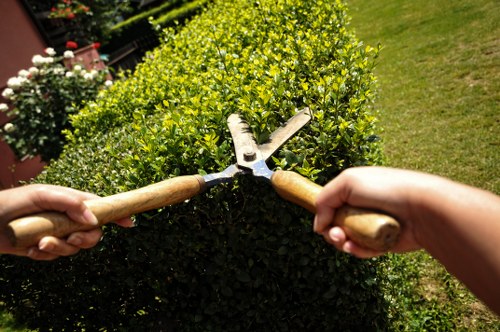
Certain hedges need a more cautious approach because of their species, age, density or position. Older hedges may have a dense outer layer but weaker growth inside, so a hard cut can expose gaps that take time to recover. Tall hedges can also be more demanding because the top and upper sides need secure access and a clear plan for achieving a straight finish. In both cases, the aim is to improve the hedge without creating unnecessary stress or a poor visual result.
Hedges beside driveways, narrow side returns or delicate planting can be awkward if the work is rushed. The cuttings need to be managed carefully, and the shape of the hedge needs to be judged from more than one angle. When a hedge forms part of a boundary, a neat appearance can matter just as much on the hidden side as the front-facing one. Tree lopping and removal is a separate service when larger woody growth needs a different kind of attention.
We also take into account how the hedge will recover between trims. Some hedges hold their shape well for long periods, while others need more regular attention to stay under control. If your hedge has become heavy, uneven or difficult to manage, it may be better to reduce it gradually and then keep it on a regular schedule. That gives a more even finish and avoids the cycle of waiting until the hedge becomes too large to handle comfortably.
Quotations and practical details
To prepare a quotation, it helps to know the hedge’s approximate height, length and general condition, along with whether access is straightforward or tight. A simple description is often enough, though photographs can help when the hedge has an uneven shape, is unusually tall or sits in a confined space. If there are sections you want kept particularly level, or if you want the work to focus on one side rather than the whole hedge, include that in your enquiry so the scope is clear.
Price can depend on the amount of cutting needed, the hedge’s density, how easy it is to reach and whether the job is a routine trim or a more substantial reduction. A hedge that has not been cut for a while may take longer to shape than one that is maintained regularly, even if the linear length is similar. About us gives you a little more background on the business, while contact us is the place to start a quote request.
If you are ready to tidy the hedge and want it handled neatly, send the details through and we will take it from there. You can also mention if the work needs to fit around a specific date or if there are access points we should know about. Clear details help us quote accurately and make sure the hedge work is planned around the right level of trimming.
Keeping hedges neat through the seasons

Hedge trimming is often most effective when it becomes part of a regular pattern rather than a one-off rescue. Seasonal growth can quickly change the appearance of a hedge, especially in a garden where the hedge forms a clear frame or boundary line. Regular attention keeps the shape defined, helps the hedge retain its screening function and reduces the chance of heavy, awkward growth taking over the space. That does not mean every hedge needs the same schedule, only that consistency usually produces the best overall look.
Some customers prefer a light, repeated trim that keeps the hedge neat without pushing it back too hard. Others want a more visible reduction followed by steadier maintenance in future. Either way, the key is to match the work to the hedge’s condition and the finish you want. Recycling and sustainability explains how green waste and cuttings are approached where relevant, which may be useful if you want to understand the broader handling of garden debris.
When you are ready to move ahead, a short message with the hedge’s size, type and current condition is enough to begin. If the hedge is part of a larger garden update, say so and we can keep the scope aligned with the rest of the work. For a quotation, send the details today and let us know what finish you have in mind.